
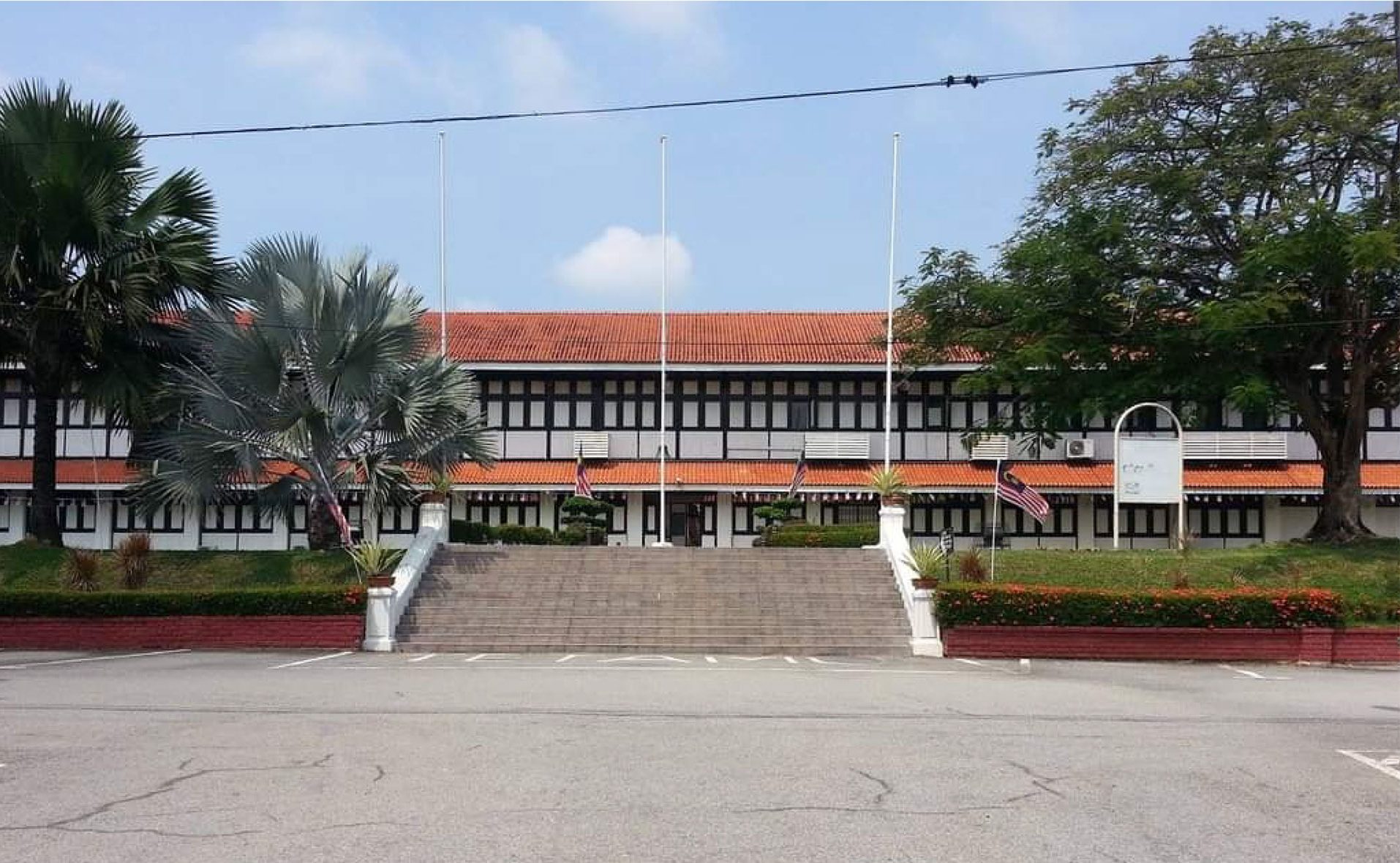
High School Bukit Mertajam, established on 18 January 1927 with approximately 300 students, is one of the oldest schools in Malaysia. Over the years, it has grown into a distinguished institution, producing many high achievers and prominent national figures, including former Prime Minister YAB Datuk Seri Abdullah bin Haji Ahmad Badawi, current Prime Minister YAB Dato’ Seri Anwar bin Ibrahim, and former Governor of Penang Tun Ahmad Fuzi bin Haji Abdul Razak, who also serves as the current Patron of the HSBM Alumni.
To honour the passing of the seventy five years in the life of an institution is very different from commemorating someone’s birthday particularly when it involves not only the historical evolution of a school but also the changing times of a young nation such as ours.
Hardly anyone of our School’s living population of today will be able to truly comprehend the meaning of its past as we have yet to achieve a collective appreciation of how we have come to be what we both as individuals as well as citizens of a vibrant new society.
Our very name, despite repeated attempts to mangle it, has remained the same not to mention a number of other icons such as Jacob’s Green and the various houses, namely, Cheeseman, Colin King, Soon Eng Kong and Stowell.
Other snippets of our days at the school might include the delicious fare in the quaint tuck shop at the corner of the playing field, of the verdant and luscious produce of Mr Kam Kee Hock’s much loved vegetable garden between the Teacher’s Quarters and the H.M.’s house, or even the ubiquitous office, visits to which, for many, invariably ended with a sharp pain in the buttocks!
It is these things, both living and inanimate, that collectively make up one’s memories of what it was to be a HSBM boy.
They are, indeed, the tangible links with our historic beginnings and our colourful pre-Merdeka past but what of the less physical and readily visible ties that give each and every one of us as Old Boys a warm and comfortable feeling of pride and a sense of belonging?
Looking back at old photographs of the School, it is almost incredible that the men who had gathered in the town’s photo studio for a historical group picture in 1927 were to be ultimately responsible for all that the school came to be known for especially in the quality of men that it produced.
Even more, when one reads the almost unbelievably personal reminisces of some of the select few of this elite pioneering staff members in the Golden Anniversary edition of The Bukit, none of us will be able to deny the utter sincerity and total dedication of these early teachers.
It was this core of pioneer teachers whose names are now just a memory that was the backbone of the School’s rise to fame from a backwater such as Province Wellesley.
As we observe the seventy fifth anniversary then, we ought to be acutely aware of their absence today as they have almost all to a man faded away with the passing of time and we’re left only with our fond memories of them.
Looking back at the emergence of HSBM since 1927 from the current standpoint, one of the first things that strikes you is the simple fact that exactly thirty years after it was established we became an independent nation.
Thus, in a sense, the greater part of our school’s history has been very much our own responsibility and, yet, the question that begs to be asked is: Just how much has the old School changed during this relatively short span of time?
One does not expect any simple answer to such an intriguing way of assessing our past seventy five years but it needs to be borne in mind that change is inevitable, for nothing is static in history.
And yet, the older alumni amongst us quite often find it rather a challenge to have to concede that time and tide have indeed waited for no man and that our alma mater after seventy five years may indeed be much more hallowed institution today than it once was!
Apart from a short break caused by the Japanese Occupation, HSBM went on to challenge and, very often, soundly beat not only its immediate rivals in the rarefied confines of the Peninsula for more than half a century.
HSBM would have never amounted to much if it had been just another British colonial institution to educate the natives among a motley gathering of rice farmers, rubber tappers, civil servants and petty traders.
Undoubtedly, the vision of the founding father, E La M. Stowell, to mould the newly established school along the strict but slightly elitist lines of the English public school model has much to do with the nurturing of the school’s character.
But, surely, the amazing thing is that this no doubt well intentioned aspiration was left in the somewhat unusual charge of a small band of valiant locals and it is entirely to their credit that we have become what we are today.
Most old boys of the pre-Merdeka years will never be able to forget the names of these archetypal Malayan gentlemen of that period when, as a Malay, Chinese or Indian or Eurasian in what was then British Malaya, they were all caught in a fascinating dilemma.
Themselves thoroughly schooled in the British educational tradition and yet ethically not entirely detribalised, one remembers them as neatly attired in stiffly starched, usually white, long-sleeved shirts and trousers with their de rigueur ties.
In recalling the glorious record of HSBM’s seventy five years but we are all undoubtedly very conscious of that proud tradition in the initial years of our nation’s rise to greatness.
The conservation of HSBM is, after all, a permanent symbol of the rise of this part of Penang from being an unknown rural countryside in the early part of the last century to a bustling high-tech industrial society in which the old school continues to outshine its rivals both academically and in sports.
In the beginning years, morning assembly was held in the school hall. as the Headmaster strode up the stairs leading to the stage, where the teachers were seated in a semi circle, the Colour Captain (or House Captain) on duty would step on to the “Castle”. The “Castle” was a platform about one and half feet high and a yard square. It had four massive but beautifully carved legs, and a couple of steps led up to it. The “Castle” was placed immediately in front of the stage on the cement floor. In his hand the Colour Captain held a wand ended in a knob on whic was mounted a trophy which the Colour or House has won. The trophy was usually in the form of a statute. The Colour Captain led the boys in reciting “The Compass” and in singing the “Colour Song”.
The value of this ceremony cannot be expressed more briefly than in the words of our founding headmaster, Mr E. La M.
Stowell; “As, in Malaya, the boys have so many regions, I think something, like the Compass or Statement, is the best kind of substitute we can give them for good, shared, basic ethical purpose with which to start the day.” Moreover he said, “They lend solemnity, and a little ceremony and formality to the opening of the School Day”
CAPTAIN
It is…..
ASSEMBLY
It is…..It is our bounden duty to uphold the Honour of the School at all times and in all places, both now as boys and later as men and old boys. The Honour of the School will not be upheld by talking or writing. It is by his conduct that a man is judged: his deeds speaks louder than words, and in a little example persuades more than precept.
From the School more is to be learnt than the wisdom of books: the conduct of a good man and true may be learnt at school.
A good man and true scorns to succeed by means that are dishonest. He never gives in, he never admits defeat. After being punished or blamed, he does not sulk or complain. He never deserts his friends, his Colour or his School under any circumstances. Above all he will stand up for the king, the king who keeps his enemies beyond boundaries within which we live and without which, murder, oppression, famine and robbery would stalk through province. To him while we shelter beneath his flag, gratitude and goodness demand our outspoken loyalty.h
A School by the Bukit
A High School Bukit Mertajam Song
In the land that is north,
There’s an old great school we hear,
Famous sons and daughters have sailed forth,
borne their honour far and near.
Some have fought and conquered ‘dragons’,
others nature’s secrets won.
Here within out sunkist province
Deeds are waiting to be done.
At the high school by the Bukit where Mertajam lies her plain.
Rears her head the boys are ready,
to face danger, conquer pain.
To the future we’ll preserve.
with these proud words as our guide
Aut Coepisse Noli Aut Confice
We’ll take everything in stride, Everyday you’ll see us toil,
without grouse without whine.
And everybody you’ll see us stand tall,
till the sun has ceased to shine.
Everyday, you’ll see us stand tall, till the sun has ceased to shine
The original staff to assist Headmaster E. La M. Stowell comprised the following:
Some of our very senior alumni will find this nostalgic. These are personalities who by example and precept, have in many ways influenced them in their careers.
Mr Ong Chin Huat was for years the Games Master of the school. He was all-round sportsman, of a very genial nature, painstaking and sound in judgement. He left his mark on the games of the school right up to the time of the Japanese Invasion when he died in the enemy prison.
Mr Philip Aeria will be best remembered as the boxing instructor. In the middle 1930s, he trained the likes of S.Plainiandy, A. Rahim and Mohana Krishnan who, upon leaving the school made their pugilistic fortunes in Singapore. Captured by the Japanese he survived the war but came out a broken man and though given light duties at HSBM he succumbed to his wartime incarceration.
Mr Oh Boon Tat will live long in the memory of High School old boys for his dedication to both classroom and outdoor duties. There was not a single department to which he had not contributed useful ideas and given practical help – even the HSBM crest was designed by him. In class he taught only mathematics, but on the field he was concerned with all games, particularly cricket, rugby and athletics. He was fastidious about the grounds and spared neither himself nor the kebuns and members of the Jacob’s Green Society. He would spend hours coaching promising athletes and players and even more hours every week giving extra tuition to boys taking Higher Mathematics for the School Certificate Examinations.
Mr Chan Ewe Pin was a man of the world even when he joined the staff as a young man of 24 from the Anglo-Chinese School in Bukit Mertajam. Respected and looked up to as teachers generally were in those days, he mixed with the upper and the lower classes of the society alike without demening himself. He was mainly instrumental in bringing back to the HSBM offers of scholarships, games trophies and help in various forms. His efforts brought philanthropic personalities like Soon Eng Kong, Heah Seng Whatt and M Sarvanamuttu, to the aid of the school. He capped his service to the Bukit Mertajam with a term as Town Councillor and there is a road in town bearing his name.
Mr Kam Kee Hock was chosen from the very start to help Mr Stowell in scouting. The Headmaster, himself the strict Scout Master, personally took charge of this activity as he strongly believed it was the best medium for character building. Kam Kee Hock took a like long interest in scouting, eventually being appointed Asst District Commissioner for Province Wellesley. He was also successful as a gardening master and its reported the lettuces his gardeners produced for several seasons became famous even outside the province. He later became the supervisor of Stowell School – the feeder primary school to HSBM. He was truly a dedicated teacher and a perfect gentleman.